
Energy Storage Becomes a Key Differentiator for Large Renewable Energy Projects in Mexico
Energy storage is becoming a defining factor for large-scale renewable energy projects in Mexico, and Huawei Digital Power aims to position itself as one of the country’s leading providers in this sector.
The company already supplies energy storage solutions for Puerto Peñasco, the flagship renewable energy project of Mexico’s Federal Electricity Commission (CFE) in the state of Sonora. The project currently serves as Huawei’s primary success story in Mexico and forms the foundation of its goal to capture at least 30% of Mexico’s energy storage market by 2030.
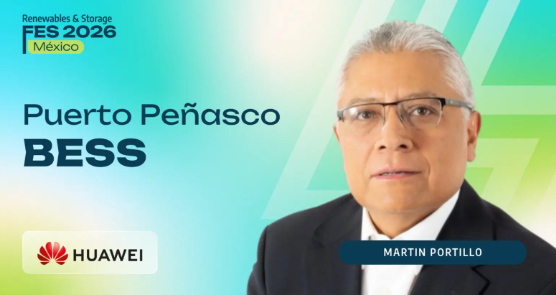
“We are cooperating with them on the energy storage portion, and we are also in the process of offering our inverter portfolio,” said Martín Portillo, Director of Strategy at Huawei Digital Power.
“One of the key contributions we are making is the deployment of new technologies such as grid-forming,” he added.
Huawei Promotes String Inverter Technology
The company is promoting the adoption of string inverters, an architecture that it says improves both the technical performance and the financial returns of solar power plants.
According to Huawei, this technology provides not only advanced engineering advantages but also economic improvements that increase overall project profitability.
Puerto Peñasco Continues to Expand
The Rafael Galván Maldonado Photovoltaic Power Plant, better known as Puerto Peñasco, is considered one of the flagship projects of the CFE’s energy transition strategy.
The project’s first two phases are already operational, providing:
- 400 MW of photovoltaic generation
- 72 MW of battery energy storage
This makes it one of Mexico’s first large-scale solar projects to integrate battery storage.
Expansion will continue over the next several years.
According to Emilia Calleja, Director General of the CFE:
- Phase Three is expected to begin commercial operation in December 2027, adding:
- 300 MW of solar generation
- 90 MW of Battery Energy Storage Systems (BESS)
- Approximately $294 million USD in investment
- Phase Four is scheduled to begin in March 2028, adding:
- 280 MW of photovoltaic capacity
- 84 MW of battery storage
- Approximately $344 million USD in investment
Once completed, the Puerto Peñasco complex will reach a total capacity of 1,000 MW, making it one of the largest solar parks in Latin America.
Developers Now Prioritize Reliability Alongside Financial Returns
The growing demand for energy storage reflects changing priorities among renewable energy developers.
According to Portillo, private companies and public institutions have different objectives, although both increasingly require advanced storage technologies.
For private-sector developers, the primary concern is achieving a strong return on investment.
Huawei therefore seeks to offer business models tailored to each customer’s financial expectations.
For projects developed by the Federal Electricity Commission (CFE) and other public entities, priorities shift toward:
- Long-term reliability
- Operational durability
- State-of-the-art technology capable of supporting public energy infrastructure
Hybrid Projects Are Changing the Market
This shift also explains Huawei’s optimism regarding future growth in the storage sector.
Battery systems are no longer being requested only for large government-owned projects but are increasingly becoming standard components of a new generation of hybrid renewable energy developments.
These developments coincide with major changes in Mexico’s electricity sector.
Following the award of 7,400 MW across 37 mixed public-private projects developed in partnership with the CFE, Mexico’s Ministry of Energy (SENER) is preparing another round of projects totaling more than 6 GW, including:
- Priority renewable energy projects
- Additional mixed public-private developments
- Competitive tenders specifically focused on energy storage
These initiatives position battery storage as one of the fastest-growing segments of Mexico’s renewable energy market.
Huawei Targets More Than 30% Market Share
Huawei believes the opportunity extends well beyond projects currently under construction.
According to Portillo, utility-scale projects exceeding 200 MW require several years to complete.
Projects being planned today are expected to finish construction around 2027, with commercial operations beginning in 2028 or 2029.
That timeline aligns with Huawei’s long-term growth strategy.
“Our goal is to achieve a significant market share. We would like it to exceed 30%,” Portillo said, referring to the company’s objective for 2029–2030.
FusionSolar 9.0
Huawei also introduced its technological roadmap during the Future Energy Summit Mexico, unveiling FusionSolar 9.0, a new generation of photovoltaic and energy storage solutions featuring:
- Improved operational intelligence
- Enhanced battery system safety
- Greater integration capabilities with electrical power grids
Source: energiaestrategica